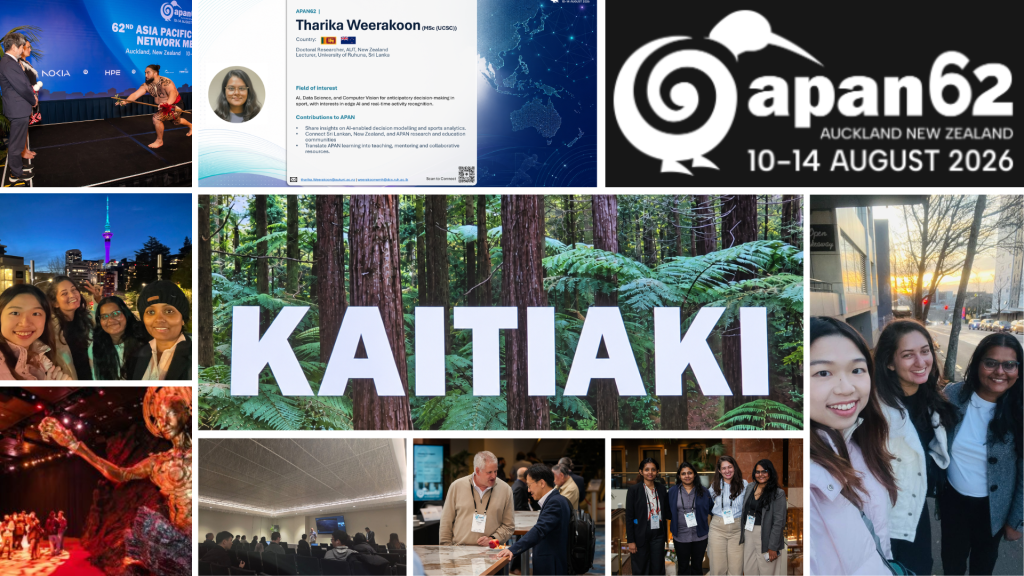
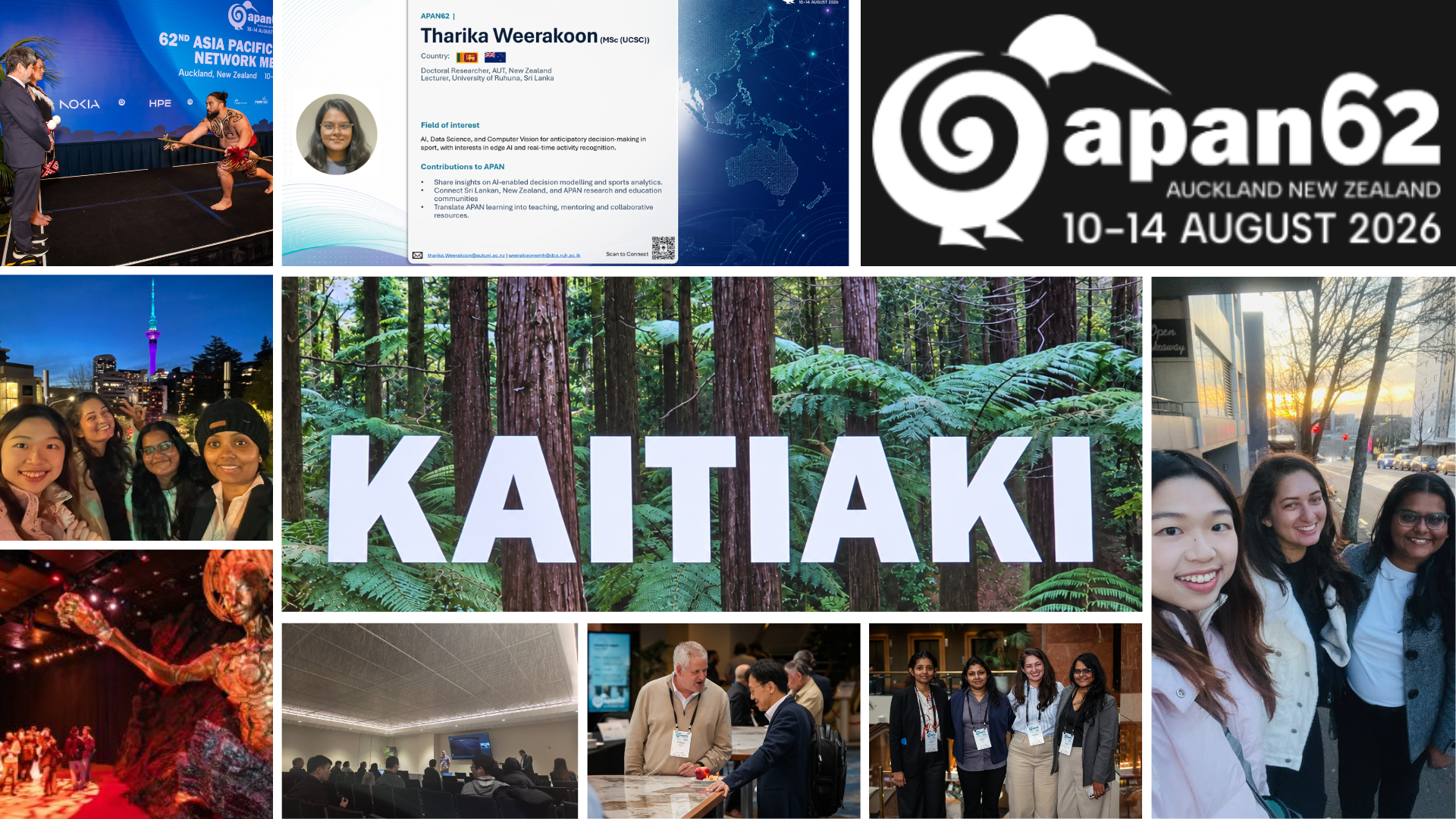
Building Connections Across Research, Education and Community: My APAN62 Fellowship Experience
By Tharika Weerakoon
APAN62 Fellow
Doctoral Researcher, Auckland University of Technology, New Zealand
Lecturer, University of Ruhuna, Sri Lanka
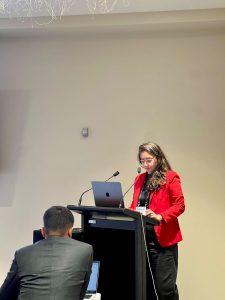
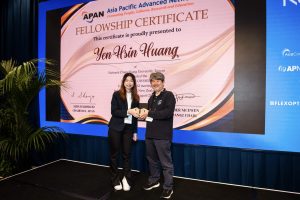
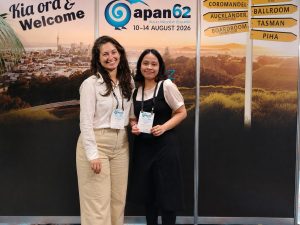
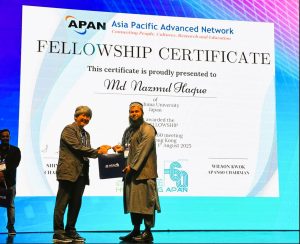
Participating in APAN62 from 10–14 August 2026 as an in-person APAN Fellow was a meaningful academic, professional, and personal experience. Throughout the week, I had the opportunity to engage with researchers, educators, technical experts, Working Group members, and fellow early-career academics from across the Asia-Pacific region.
One idea that stayed with me from the opening ceremony was the word Kaitiaki, shared as the Māori word for guardians. It was expressed in a way that reminded us that, in many ways, we are all guardians: guardians of knowledge, research culture, collaboration, communities, and the future networks we are helping to build. This message gave a meaningful tone to my APAN62 experience, especially as the event was hosted in Aotearoa New Zealand.
As someone originally from Sri Lanka and currently living in New Zealand as a doctoral researcher, APAN62 felt especially significant. It gave me the opportunity to experience the Asia-Pacific research and education community from a shared regional perspective. I was not only attending sessions; I was also learning how communities are built, how collaborations are sustained, and how people from different countries and disciplines come together around common goals.
My academic interests are in artificial intelligence, data science, computer vision, and anticipatory decision-making in sport. However, APAN62 helped me see these interests within a much wider context: open science, research infrastructure, high-performance computing, responsible AI, education, rural health, and regional collaboration.
Learning Through Open Science and Research Communities
One of the most valuable sessions I attended was the Open Science Collaborative & Resource (OSCR) Working Group session. The session highlighted that open science is not simply about making research outputs publicly available. It is also about building the technical, institutional, ethical, and cultural foundations that allow data, software, and knowledge to be shared meaningfully.
The discussions on open science policies, research data infrastructure, AI-supported metadata generation, FAIR practices, and research software sustainability helped me understand open science as a complete ecosystem. It depends not only on platforms and policies, but also on people, trust, skills, and long-term community engagement.
I found the discussions on research software engineering particularly meaningful. They reminded me that behind research outputs there are often people developing tools, maintaining code, supporting infrastructure, and enabling others to conduct research. This human and community dimension of research infrastructure was one of the strongest lessons I took from the session.
AI, HPC and Responsible Digital Futures
The HPC/AI Working Group sessions were closely aligned with my background in computing and AI. One presentation that stood out to me discussed how agentic language models can reduce barriers to supercomputing. Advanced computing environments can be difficult for new users because they often require command-line interaction, remote access, job scheduling, and distributed execution. The idea of using AI as an adaptive support layer showed how technology can help researchers become more confident and independent users of advanced infrastructure.
Another important discussion focused on trustworthy, secure, and sustainable AI for collaborative research and education in the Asia-Pacific region. This session reminded me that AI adoption should not be measured only by performance or automation. It must also consider trust, security, energy use, resilience, ethics, accessibility, and sustainability.
I also attended a hands-on workshop on using AI tools for academic research and teaching. This session was especially relevant to my dual role as a doctoral researcher and lecturer. From a research perspective, it encouraged me to reflect on how AI can support literature review, academic writing, research design, and data analysis. From a teaching perspective, it made me think about how students can be guided to use AI tools responsibly while still developing their own critical thinking and academic skills.
Connecting Technology with Real-World Needs
Some of the sessions I attended were connected to medical and rural health applications. These were particularly interesting because they related to my previous work on NVIDIA Jetson-based edge AI for rehabilitation and real-time activity recognition.
The rural health discussions helped me reflect on how AI and digital infrastructure can support communities where accessibility, cost, connectivity, privacy, and real-time processing are important. They also reinforced the need to design technologies that are not only technically advanced, but also practical, deployable, and meaningful in real-world contexts.
I also attended the Agentic Workflows for Network Observability Workshop, which introduced the use of agentic AI in network monitoring and operational decision-making. Although this is outside my direct PhD research area, I found it useful because it showed how AI can support complex, dynamic environments. It also made me think more broadly about decision-support systems across different domains, from sport and rehabilitation to infrastructure and network operations.
Shadowing Through the APAN Future Leaders Program
A particularly meaningful part of my fellowship was participating in the APAN Future Leaders Program, which included a shadowing component. This initiative allowed fellows to closely observe a Working Group and gain first-hand insight into what it takes to support, coordinate, and sustain APAN community activities.
Through this programme, I had the opportunity to shadow Dr. Buseung Cho, Director and Professor at the KREONET Center, KISTI, University of Science and Technology, South Korea. Dr. Cho chaired the Science and Education Engagement session, and shadowing him gave me the opportunity to observe APAN from a more engaged and community-oriented perspective.
I was able to see that Working Group leadership involves much more than chairing a session. It includes planning, communication, coordination, member engagement, and the ability to guide meaningful discussion. I also had the opportunity to speak with Dr. Cho about how he brings a session together. He shared that successful sessions are built through continuous engagement with the science and education community, regular networking, and the gradual development of rapport with people over time.
This was one of the most valuable insights of the fellowship for me. It helped me realise that academic communities are not built only during formal meetings or conference sessions. They are built through consistent communication, trust, shared interests, and human connection. Dr. Cho’s approach showed me that community building is an essential part of sustaining research culture and creating opportunities for future collaboration.
Beyond Sessions: The Human Side of APAN
One of the most memorable aspects of APAN62 was the opportunity to connect with other fellows and participants at a human level. As a Sri Lankan academic currently based in New Zealand, I found it meaningful to meet people who were also navigating different academic, cultural, and professional spaces.
The conversations I had during APAN62 were not limited to research topics. They also included discussions about academic journeys, opportunities, challenges, cultural experiences, and future aspirations. These interactions reminded me that regional collaboration is not only built through projects and infrastructure, but also through friendship, trust, encouragement, and shared experience.
APAN62 gave me a stronger sense of belonging to a wider Asia-Pacific research and education community. It also helped me think about how I can contribute to connecting academic communities in Sri Lanka, New Zealand, and the broader APAN region.
Looking Forward
My APAN62 fellowship experience strengthened my understanding of research culture, open science, responsible AI, education, and community leadership. It also encouraged me to think more seriously about how I can contribute to APAN beyond attending sessions.
As a doctoral researcher, I hope to share insights from my work in AI-enabled decision modelling, sports analytics, computer vision, and real-time activity recognition. As a lecturer, I hope to bring the knowledge gained from APAN62 into teaching, mentoring, and student engagement.
The APAN Future Leaders Program also encouraged me to see leadership as a gradual process built through participation, communication, and service to the community. Through shadowing Dr. Cho, I learned that meaningful contribution begins with showing up, listening carefully, building relationships, and remaining connected.
Overall, APAN62 was a valuable and inspiring experience. It expanded my academic perspective, strengthened my regional connections, and reminded me that research and education communities are sustained not only by technology and infrastructure, but also by people, trust, and long-term collaboration.
Author: Tharika Chalani Kumari Weerakoon, Auckland University of Technology