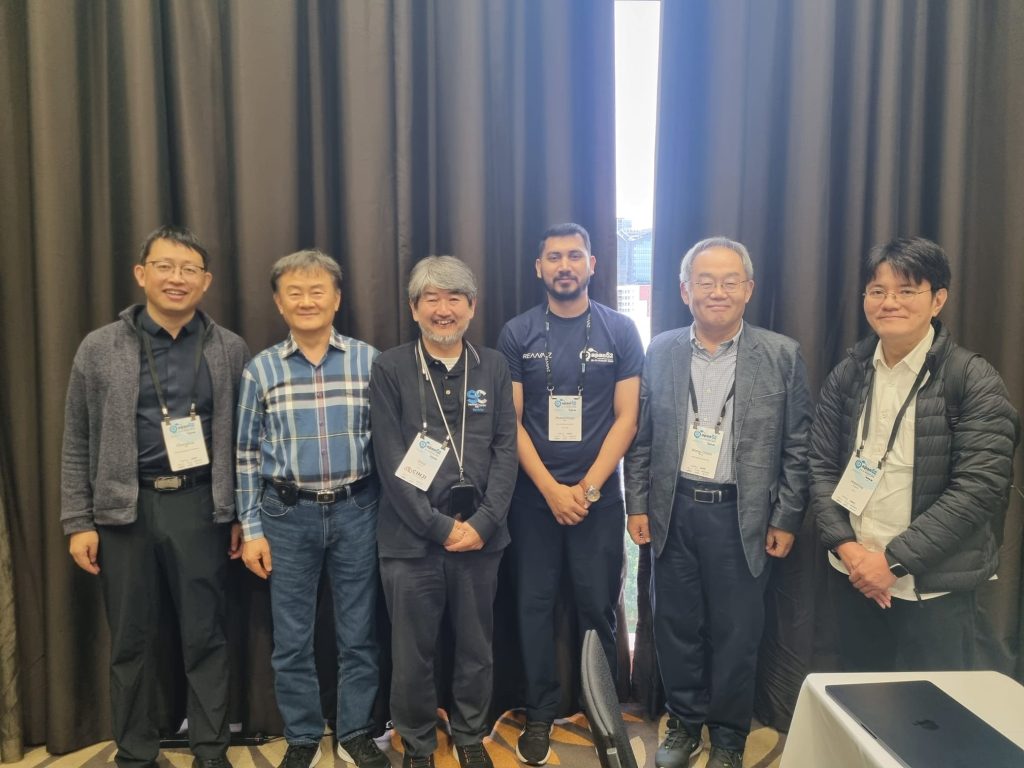
APAN62 Fellowship, Presentation, and Shadowing Experience
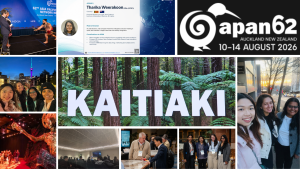
Participating in APAN62 in Auckland, New Zealand, from 10 to 14 August 2026 was a rewarding week, and a very different one from my first APAN. I attended APAN61 in Dhaka in January as a session speaker in the Asia Pacific Research Platform Working Group, still learning how the meeting fits together. I came to Auckland as an APAN Fellow, a presenter in the AI-driven Networks Working Group, and a participant in the Future Leaders Program shadowing initiative.
I am sincerely grateful to the APAN Secretariat for selecting me as a Fellow, to REANNZ for hosting the meeting so well, and to Prof. Wang-Cheol Song, Chair of the AI-driven Networks Working Group, for the opportunity to present and for his guidance throughout the shadowing programme.
Sessions attended
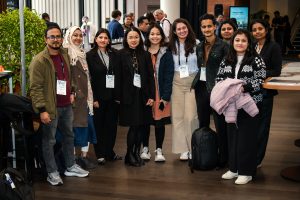
The week began with the Fellowship Meeting on Monday, which set out APAN’s structure, the role of its Working Groups, and the purpose of the Fellowship Programme. It also put all the fellows in one room before the programme properly opened, so by the Opening Ceremony on Tuesday I already knew a number of people. The Fellowship Alumni Meetup that evening connected this year’s fellows with people who had come through in earlier years and stayed active in APAN, which made clear that the Fellowship is an entry point into the community rather than a one-time award.
Monday afternoon I spent in the Open and Data Sharing toward Open Science Working Group. Open science policy sits some distance from my work on network orchestration, and that is precisely why I chose it. Many of the barriers discussed were organisational rather than technical, and would not be solved by any amount of engineering.
On Tuesday I attended the BGPWatch training and workshop delivered by Tsinghua University, covering how institutional Autonomous System networks are onboarded and how BGP events such as routing anomalies and prefix visibility issues are monitored. Working through routing analysis on a live platform is a different kind of learning from reading about it. Later that day I joined the IoT Working Group, which brought in constraints that rarely appear in my own experiments: intermittent connectivity, constrained devices, and deployments where the network cannot be assumed to behave.
On Thursday I attended both blocks of the Security Working Group, the furthest session from my own field and probably the one I have thought about most since. My framework depends on acting automatically on inferred intent, and a room full of security practitioners is a good place to recognise how carefully that needs to be approached. An orchestration system that scales and migrates workloads on its own judgement is also one that can be misled. That has already changed how I think about the assurance layer in my design.
Presenting at the AI-driven Networks Working Group
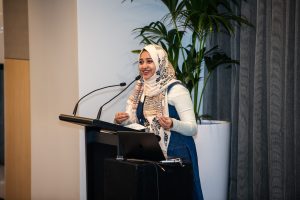
My own session came on Wednesday morning, in the AI-driven Networks Working Group, which met in two blocks in Tui II under the chairmanship of Prof. Wang-Cheol Song. I presented work titled “Immersive Intelligence: ST-GNN-Guided and RL-Optimized Multimodal Intent-Driven Kubernetes Orchestration for 6G Resource Management,” carried out at the Networks Convergence Lab, Jeju National University.
The idea is simpler than the title suggests. Kubernetes autoscaling today is largely reactive: it responds after demand has already changed, which costs latency and SLA compliance precisely when the workload is least forgiving. Immersive 6G applications, generating highly dynamic load from image, audio, and motion data, are a demanding case for that model. Our framework instead interprets user intent from multimodal inputs, verifies that intent before acting on it, forecasts upcoming CPU, memory, bandwidth, and latency demand using a spatio-temporal graph neural network, and lets reinforcement learning agents make the scaling and placement decisions.
The results drew the most engagement from the room. Against the baseline, the framework reduced end-to-end latency by 21 per cent, SLA violations by 19 per cent, and CPU over-provisioning by 15 per cent, with intent recognition at 95 per cent accuracy and the control loop executing in under 33 milliseconds. Forecasting remained stable across thirty days without noticeable drift. I was also clear about the present limitation: the evaluation runs in a virtualised multi-zone environment on a single physical machine. Extending it to genuinely distributed, multi-cluster infrastructure is the next step, and the step where a community like APAN becomes directly relevant. The discussion continued well beyond the session, and several of the exchanges that mattered most happened over tea rather than in the room.
Future Leaders Program: shadowing a Working Group Chair
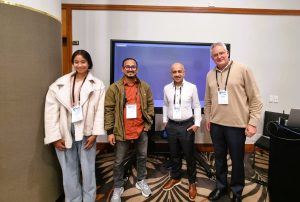
I also took part in the APAN Future Leaders Program, under which the Secretariat pairs selected fellows with a Working Group Chair for a meeting. I was paired with Prof. Wang-Cheol Song, Chair of the AI-driven Networks Working Group and also my doctoral supervisor at Jeju National University. I shadowed both AINWG blocks on Wednesday, with four areas to observe: how a Chair prepares and plans WG sessions, coordinates with WG members, conducts and manages the meeting itself, and leads the wider business of the Working Group.
The clearest lesson was how little of chairing actually happens at the meeting. The session in Tui II was the visible part, but the agenda behind it had been assembled over months: identifying who had work worth presenting, sequencing talks so the session held together as a coherent argument rather than a series of unrelated slots, judging what belonged in the Working Group and what was better placed in the co-located conference, and coordinating with co-chairs across NICT in Japan, CSTNET in China, and King Fahd University of Petroleum and Minerals in Saudi Arabia. The mailing list carries more of the Working Group’s work than the meeting room does. Running the session on the day was, by comparison, the straightforward part.
Shadowing also clarified something about my own position in the Working Group. AINWG’s goal is to help APAN members move from traditional network operations centres toward intelligent ones, using AI to identify patterns across alarm and event streams and automate incident handling without hand-written expert rules. That is an operational ambition as much as a research one, and it can only be tested against networks carrying real traffic. My framework performs well in a controlled environment, but I cannot know how it behaves under real production conditions until it runs there.
Closing thoughts
I am grateful to the APAN Secretariat, to REANNZ and the organising team, to Prof. Wang-Cheol Song, and to the fellows and participants whose conversations shaped my week. The Fellowship and the Future Leaders Program have given me a clearer understanding of how APAN works and a stronger sense of where I might contribute. I intend to stay involved with the AI-driven Networks Working Group and look forward to continuing this collaboration in the meetings ahead.
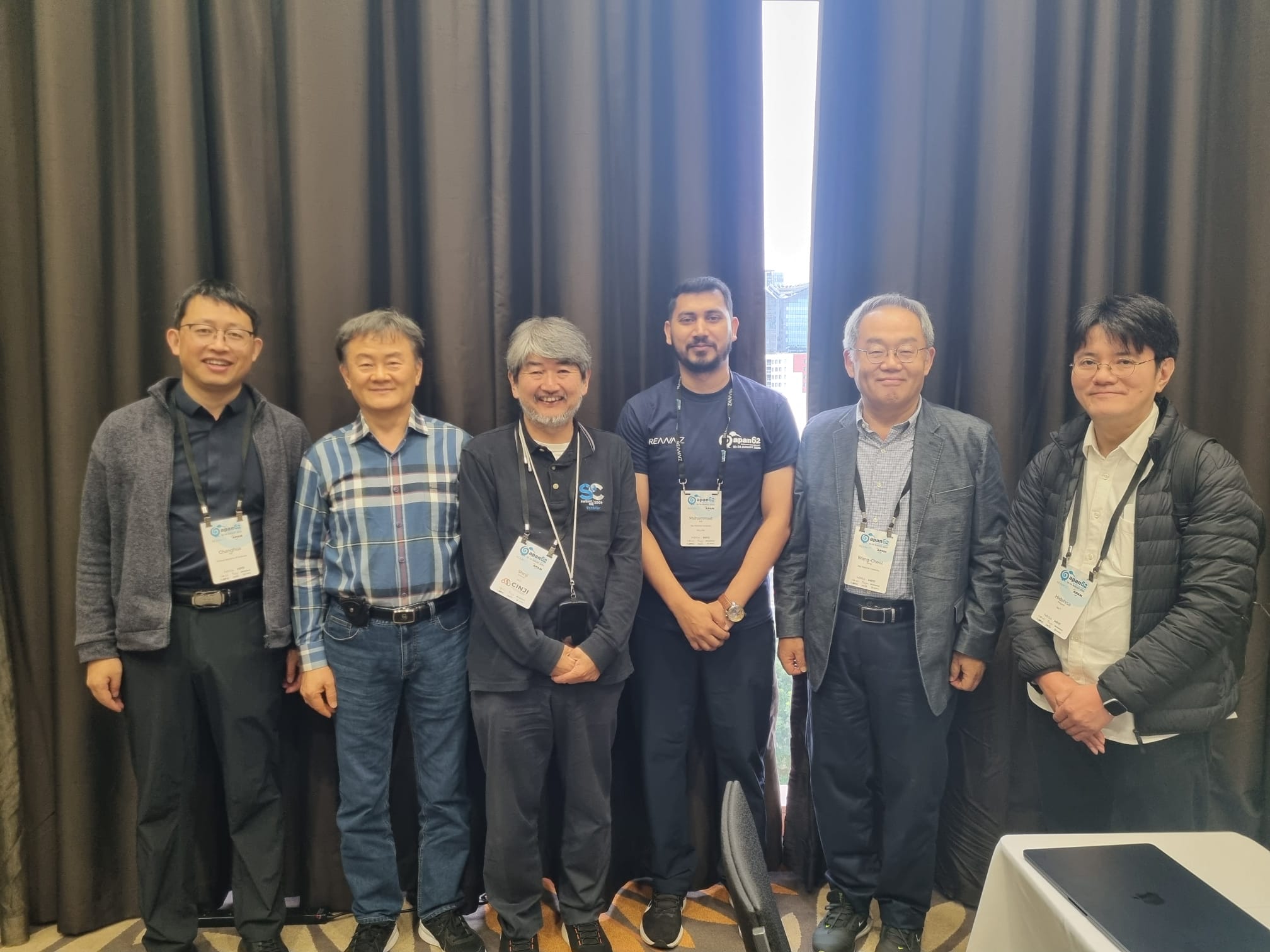
Author: Muhammad Asif, Jeju National University, Republic of Korea