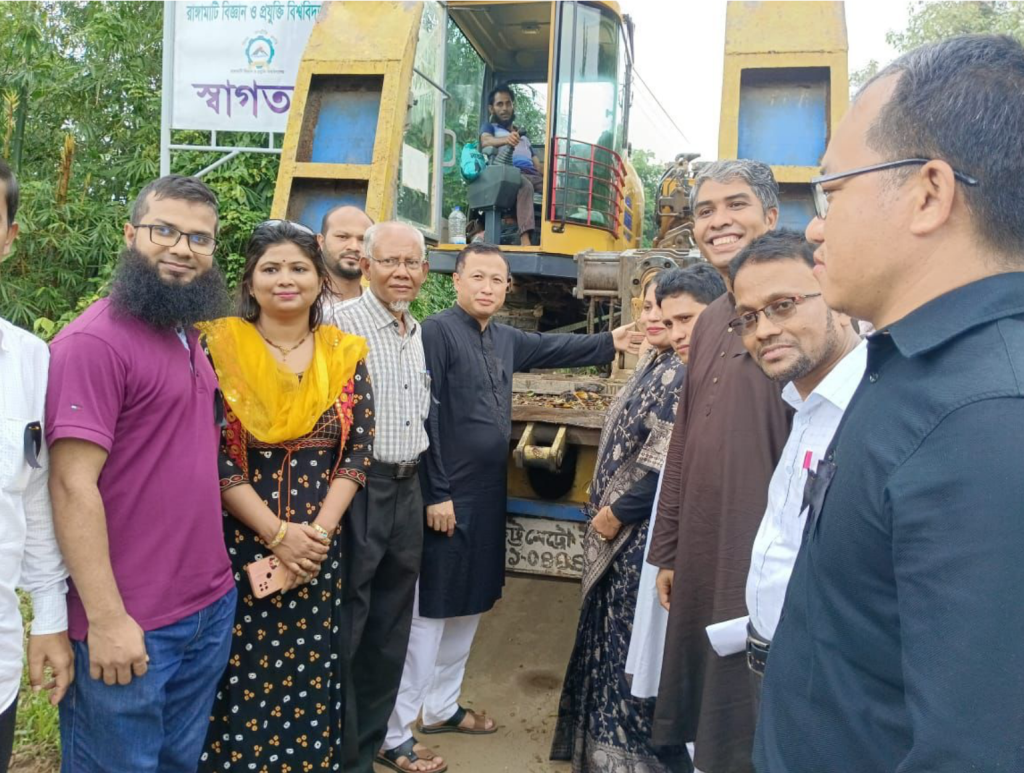
Rangamati Science and Technology University (RMSTU), located in the hilly and mountainous zone of the southeast part of Bangladesh bordering India on the west, was established in 2013 to support the marginalized and ethnic community in the Chittagong Hill Tracts region. The university, the first in the hilly region of Chittagong, stands on top of a hill overlooking the picturesque view of the free-flowing and all-encompassing Rangamati Lake, which embodies a scenic symbol of beauty and pride for the country. However, supporting the university students with state-of-the-art technologies and services in that highly inaccessible zone has been a perennial challenge. Establishing high-speed internet connectivity stood topmost among these challenges.
Overcoming the odds, the university started its operation with a bandwidth capacity of 50 Mbps from a local internet service provider. Not only was the bandwidth minimal for a student capacity of 500, but the connectivity was also unstable. There was no connectivity backup as the ISP was the lone service provider. Both the last mile connectivity – established through overhead cable – and the core of the ISP – with low power backup – were sources of disruption of services.
The Honourable Vice-Chancellor approached BdREN to come up with a solution. But how to do that? The terrain was mountainous with rock-hard soil, making the laying of optical fiber cable increasingly difficult – if not impossible. The meandering route with frequent twisting and turning all its way and the slope of the highway in few places were real scares for the cable-laying operators to use Horizontal Directional Drilling (HDD) technology. On top of that, the frequent erosion of soil barred the open-cut solution as the road authority declined to permit that method, apprehending the fallout of landslides from erosion of hills.
It is worth mentioning that BdREN is used to providing high-speed internet connectivity to universities using the Optical Ground Wire (OPGW) network of the Power Grid Company of Bangladesh. In the case of RMSTU, the nearest PGCB site is situated around 14 km away at the far end of the city. BdREN made frequent surveys to figure out solutions like a combination of open-cut and underground, but it remained unmaterialized due to the challenging terrain.
Finally, BdREN could convince one of the operators to emerge from their shell and come forward to take the challenge. It was decided that for most of the route, the cable would be laid through HDD technology of very short lengths. The open-cut method would only be deployed if the terrain was too unsupportive. A survey drawing was prepared and submitted to the road authority for permission. The Honourable Vice-Chancellor herself took the leadership and convinced the local member of parliament about the justification and urgency of doing the work, which eventually resulted in getting permission from the road authority, but that also took months. The permission was conditional with BdREN taking responsibility for making all sorts of compensation for any erosion of soil or damage to the road.
With close supervision from BdREN, the cable-laying operator started its work. As mentioned, the soil was too rocky, and each HDD shot – which normally goes 150 to 200 meters – could hardly work for more than 50 meters, and not more than two shots were possible per day. The local operator engaged two machines, one from the university side and one from the PGCB side, even though the progress was too slow. As Md. Kawser, BdREN’s optical fiber technician engaged in supervision of the cable laying, says, “The soil being too rocky compels downsizing the length of the shots. The scarcity of water, a mandatory element for HDD, made the work even harder as the operator had to collect water from a few miles away using a special cart. Also, the high slope of the road in a few areas made it challenging to set up the HDD machine.”
The problem didn’t end there. One fine morning, it was reported that work had been stopped because the boring drill, along with the “sonde”, which is used for guiding the drilling and of high cost, got stuck at a depth of 20 feet from ground level and became unrecoverable. This caused significant financial loss for the operator. BdREN decided to bear the damage and convinced the operator to start its work again.
There were other unpredictable issues that were not apprehended at all. The dominance and unchallenged operation of local extortionists were a major issue. The area is dominated by ethnic terrorists who pose a threat even to law enforcement agencies. The latter don’t want to create any obstacles to the former’s illegitimate and illegal business, let alone stop them, apprehending that might generate ethnic commotion. After a few days, when those extortionists learned that such work had started, which could generate a scope of business, they came out of nowhere, kidnapped one of the operator’s workers, and started demanding ransom. The work stopped again. It was life-threatening for the operator and also for BdREN, which was actively involved in the supervision of the operation. The law enforcement agency didn’t want to intervene and requested BdREN to resolve the issue mutually. The situation was so scary that the BdREN employees were afraid of passing nights in that locality with the apprehension that they might also not be spared. However, after a series of bargaining and with the involvement of the RMSTU authority, the concerned employee was freed with the payment of a huge ransom and a commitment from the extortionists to allow the continuation of the work. As the representative of the operator revealed “Each time I had been to the negotiation table, I used to be blind folded to the deepest part of the forest and once my eyes were opened, I used to find myself surrounded by armed personnel. It was so intimidating that the scare still haunts me. I had never experienced such horror in 15 years of my working in this industry”.
Moreover, it was beyond imagination that this control of the extortionists was based on territory. Once the territory was crossed, it went under the control of another group, resulting in a renegotiation and repetition of the same process. Finally, with six months of rigorous and untiring efforts, the end-to-end connectivity was established.
As Prof. Dhiman Sarma, the dean of the computer science department, explained the situation: “I didn’t understand the challenge pertaining to the work initially. But as the work commenced, the representatives of the operator started approaching me time and again with various problems, seeking solutions from my end. One fine morning I found all the HDD machines at the RMSTU premises. Upon exploration, I discovered that the operators had been threatened by the local extortionists and were apprehensive that their machines might be damaged. I sought assistance from my registrar to communicate with the local personnel to resolve the issue.”
Certainly, it was a challenge worth remembering as it resulted in many sleepless nights for BdREN officials. But as we see the happy faces of the university students and faculty members, all our pains and agonies disappear. Now the university has 1 Gbps internet connectivity, which was once a dream for the university personnel. Moreover, they have backup connectivity from another operator, making internet availability almost five nines.
As the Honorable Vice-Chancellor expressed: “Many thanks to BdREN for accepting this challenge and for coming to the rescue of the students and faculty members by providing a stable high-speed internet bandwidth that will enrich the teaching and learning environment at RMSTU. I will remain ever grateful to BdREN for making it happen, overcoming all the encumbrances, and expect that BdREN will assist in improving the infrastructure of the university in the future as well.”
This is one of the many examples of the challenges BdREN has taken on its journey to becoming one of the leading NRENs in the Asia-Pacific zone.