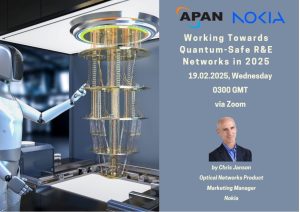
The Quantum Threat is Real: Nokia Charts a Course for a Secure Future in collaboration with APAN
A recent APAN strategic briefing, led by Chris from Nokia’s Optical Networks team, highlighted the urgent need for Quantum-Safe Networking (QSN) as quantum computing advances. While symmetric encryption like AES-256 remains secure, the public key cryptography (PKI) used across today’s digital systems is vulnerable to future quantum computers.
The Immediate Risk: Harvest Now, Decrypt Later
Attackers are already collecting encrypted data in “Harvest Now, Decrypt Later” operations, intending to decrypt it once a “cryptographically relevant” quantum computer exists. A Global Risk Institute report estimates a 15% chance of such a computer emerging within five years, putting long-term sensitive data—government, corporate, and personal—at risk today.
A Multi-Layered Quantum-Safe Strategy
The session emphasized that no single technology can solve the quantum threat. Instead, a combined approach is needed:
-
Strengthen lower layers with symmetric encryption (AES-256) and avoid vulnerable asymmetric key exchanges.
-
Post-Quantum Cryptography (PQC) using NIST-approved algorithms like CRYSTALS-Kyber to protect IP and application layers.
-
Quantum Key Distribution (QKD) for the most critical links, providing key exchange security based on quantum physics.
Path Forward for APAN
To support regional readiness, APAN outlined next steps:
-
Develop a collaborative testbed with partners like Nokia for NRENs to trial quantum-safe tools.
-
Encourage NRENs to seek research funding for quantum-safe pilot deployments.
-
Use APAN working groups to lead industry engagement and drive QSN initiatives.
These efforts continue through discussions at APAN59 in Yokohama, reflecting a shared commitment to building a quantum-secure future.
Using AI/ML for Network-Optimized DDoS Mitigation
APAN and Nokia hosted a webinar led by Jérôme Meyer, focusing on how Artificial Intelligence (AI) and Machine Learning (ML) can significantly strengthen defenses against Distributed Denial of Service (DDoS) attacks. The session highlighted the shift from static, rule-based protection to adaptive, intelligent, and self-learning mitigation.
Why DDoS Mitigation Needs AI/ML
DDoS attacks are growing more complex, powered by massive botnets and evolving techniques. Traditional defenses often fail because they rely on fixed rules and signatures. They may miss new attack vectors, mistake legitimate traffic spikes (e.g., streaming or e-learning) as attacks, or create false positives that disrupt real users. This rising complexity requires more adaptive and intelligent mechanisms.
How AI/ML Strengthens Defense
AI/ML enables real-time insight and automated response through:
-
Instant anomaly detection based on live traffic behavior.
-
Self-learning models that improve continuously with new data.
-
Lower false positives by understanding normal traffic patterns.
-
Automated adaptation without waiting for manual rule updates.
These capabilities make AI/ML highly effective in large, high-bandwidth networks where response speed is critical.
Key Enablers for AI-Driven DDoS Protection
Successful AI/ML deployment requires:
-
Strong data collection and observability
-
Effective feature engineering (packet rates, entropy, flow indicators)
-
Scalability to operate at line-rate across large networks
-
Continuous retraining to keep up with evolving attacks
Challenges to Address
Meyer emphasized that AI is not a standalone solution. Challenges include poor data quality, model drift, attacker evasion techniques, and operational complexity when integrating AI/ML across varied network environments.
Real-World Results
Case studies showed that AI/ML-based systems can:
-
Greatly reduce detection and response times
-
Lower false positives
-
Keep networks running even under high-volume attacks
These outcomes highlight the impact of combining automation with intelligence.
Looking Forward
The session noted several future directions:
-
Hybrid models mixing traditional signatures with AI/ML for stronger resilience
-
Feedback loops that learn from each attack to improve future defenses
-
Collaboration and information sharing across operators for stronger global protection
Key Message
AI and ML are becoming essential for modern DDoS mitigation. Networks that adopt adaptive, self-learning defenses will be far better positioned to stay ahead of evolving threats.
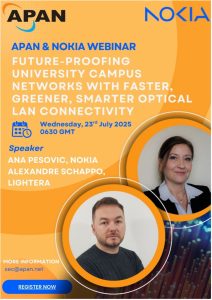
Optical LAN in Education Centers: Transforming Campus Connectivity
APAN hosted a webinar featuring Anna (Nokia’s Marketing Director for Fixed Networks) and Alexandre (Engineering Manager at Lightera) to discuss how Optical LAN is transforming digital infrastructure in education. The session highlighted why fiber-based networks are increasingly preferred over traditional copper systems.
Why Optical LAN Matters for Education
Anna explained that modern learning environments require high bandwidth, low latency, and reliable connectivity—especially with the rise of Wi-Fi 7, campus-wide digital tools, and sustainability goals. Traditional copper LANs struggle to meet these demands. Optical LAN, by contrast, offers major advantages:
-
Up to 40% lower energy consumption
-
Nearly 50% lower total cost of ownership within five years
-
Greater scalability and long-term sustainability
Nokia’s Aurelis Solution
Nokia presented Aurelis, a future-ready Optical LAN platform combining optical switches, optical modems, and a cloud-based command center. Key features include “six-nines” availability and open APIs. Aurelis is already deployed at major institutions such as the University of Otago (New Zealand) and Hong Kong University, delivering large campus coverage with fewer switches and lower operational costs.
Lightera’s Passive Optical LAN Approach
Alexandre highlighted Lightera’s passive optical LAN technologies, known for durability, low maintenance, and fast deployment. He showcased innovations like:
-
Pre-terminated fiber for rapid installation
-
Glue-based fiber cabling ideal for older buildings
These reduce disruption and installation costs. Lightera’s solutions are increasingly used across education and hospitality sectors in Indonesia, Brazil, and other regions, supported by 25-year warranties.
Technical Considerations for Campus Deployment
Both speakers emphasized the importance of Power over Ethernet (PoE) for powering Wi-Fi access points, CCTV, and other devices. PoE++ and BT standards ensure broad compatibility, while placing PoE-capable ONTs close to access points improves performance. They also discussed future technologies, including the timeline for hollow core fiber adoption.
Ongoing Engagement
The conversation continues at APAN60 in Hong Kong (28–29 July), where Nokia will further explore how Optical LAN can future-proof university and research campus networks.